
New to The Shuvah Project? what it is and why it’s necessary.
And he stood between the dead and the living, and the plague was stayed
-Numbers 17:13
Section One (Parsha Debrief):
This week’s Parsha (Numbers 16:1-18:32) contained: Korach’s rebellion, God opening the earth to swallow a bunch of people, people grumbling, God sending a plague, Aaron stopping the spread of the plague, Aaron’s sprouting staff, a description of the Levites’ portion, a tithe of the tithe, and a specific emphasis on no inheritance of land for the Levites when they enter the land.
This Parsha is named after Korach, which tells us something about its central focus. So, that’s what we’ll focus on. But, bible subtitles—like Korach’s Rebellion—are a little misleading. It too simply chalks the story up to a lesson about challenging authority.
However, there are too many questions for simplicity to win the day.
The first question to wrestle with is whether Korach’s claim is wrong. Korach says “everyone in the entire community is holy, and the Lord is among them (Numbers 16:3).” So, is he wrong? Doesn’t God tell Moses just seven verses earlier to tell the Israelites to wear tassels throughout their generations for “this way [they] will remember… and be holy to [their] God (Numbers 15:40)?” Based on that statement alone, everyone in the community IS holy.
Second, even if God didn’t say it (reminder: He does several times in Torah), is equality a bad thing to stand up for? Hopefully, most will land on no—and agree equality is something to stand for.
And, third, why now? What’s happened that makes now the time to take a stand?
If Korach wasn’t wrong about his statement of the whole community being holy, and is standing up for something worthwhile—why do he, Dathan, Abiram, and their families end up being swallowed by the earth and going down alive to Sheol?
To better understand these whys, the Rabbis at Aleph Beta suggest there are deeper motivations to Korach’s argument that might not be rooted in egalitarianism (see footnote #1).
Two conversations clue us into something else going on. Moses responds to Korach asking directly about leadership—“And would you seek the priesthood also? (Numbers 16:10b).” Yes, let’s share the leadership of the priesthood would be the expected response from Korach if equality was the root of the argument. Instead, the Text provides no response from Korach. Moses then sends for Korach’s right hands, Dathan and Abiram to inquire further. They refuse. In their refusal, they move from charging Moses and Aaron with exalting themselves to a more pointed issue—death in the desert. They seem angry.
It’s safe to assume Korach shares their anger. Being angry for equality might be justified, some might call this righteous anger. However, anger about leaving Egypt seems out of context—is it?
We enter Korach’s story after exiting the debacle with the spies. Two things happened post spies… (1) everyone in the generation of the spies—Korach & the 250 included—were told they would never set foot in the promised land, they would die wandering the desert (Numbers 14:21-23; 28-30; 35) and (2) in their denial of this reality they tried to go up into the land themselves which failed miserably (Numbers 14:40; 44-45).
Rabbi Fohrman connects the dots for us and answers—why now? He says the generation of the spies—the one that will die in the desert—is expressing its grief, specifically working their way through the Kubler-Ross grief cycle.
Imagine you were just told you have a terminal illness. Maybe you’d like to believe you’d lean on all your faith-based books and trust God. But, let’s be honest here… you, like almost everyone ever studied, would take on some progression of the grief process.
You would deny it for some time.
You would become enraged at some point.
You would find someone to blame.
Korach’s story cannot be read without understanding the mourning, the grief, and the trauma of recent, and pending death!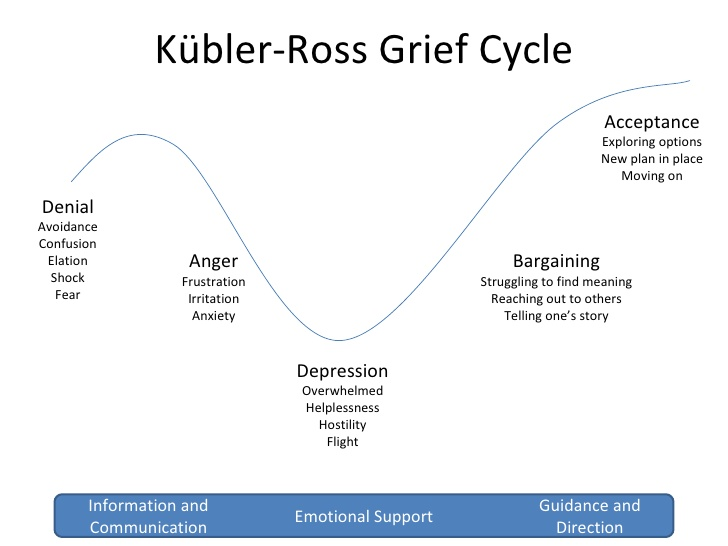
Source: CC BY-SA 4.0 DEED
The very last thing we hear from the people in this parsha is “behold, we perish, we are undone, we are all undone… (Numbers 17:12b).” That sounds a lot like a statement of exasperation and helplessness (i.e. Stage 3 of the Kubler-Ross Cycle).
Thankfully, Torah, in its infinite wisdom, guides the grieving. It gives instructions to not create bald spots on their heads (Leviticus 21:5 & Deuteronomy 14:1). That’s an odd instruction. But, not so much if we knew that this practice of tearing out hair was an ancient Amorite mourning practice. And, as if the Torah were playing a cosmic joke on Korach—wouldn’t you know it, the root of his name qōraḥ is qāraḥ—to be bald, make bald. The Sages comment that not only should the people not self-mutilate in mourning, but they also shouldn’t “make themselves into small factions (see footnote #2).” Essentially saying, as you grieve, don’t harm yourself and don’t harm your community through division.
I wonder if this generation ever made it to acceptance.
Section Two (Connection to NT + haftarah):
Acceptance—including putting a new plan in place—seems like the goal of processing grief, but look back at the bottom of the Kubler-Ross Cycle. To get to acceptance the grieving need emotional support, guidance, and direction.
In Section One, we focused on the root of the confrontation and I think we came to a solid conclusion that the Israelites were experiencing tremendous grief. What we didn’t dive into was how Moses and Aaron responded. Did they provide adequate emotional support and direction?
Not exactly (see footnote #3). But, I believe Jesus does.
Just like nothing in Torah happens in isolation, here too understanding the mourning, the grief, and the trauma the people of the Galilee are experiencing is necessary for what the author of Luke might be offering us.
We’re told Jesus and the apostles “withdrew privately to a town called Bethsaida (Luke 9:10b).” Knowing where we are in the story matters. The people of Galilee purposefully tried to avoid the violence of Rome by moving far north of Jerusalem. But, the violence and oppression found them by way of Herod Antipas and Herod Philip. To impress Emperor Tiberius, Antipas taxed the poor fishing towns relentlessly—creating what I would refer to as collective trauma.
Knowing when is just as important. The feeding event in Bethsaida comes on the heels of John the Baptist’s beheading (see footnote #4). For the people listening to John and believing him about an imminent kingdom coming, their hopes were decimated by the violence of Antipas. The death of a prophet seems like a reason to grieve and mourn. The beheading of a prophet… that’s traumatizing! Therefore, just like in Parsha Korach, the people in the Galilee experience a communal loss in the lead-up to our story.
Have you ever asked why the crowds were so intent on following Jesus that day? It seems prudent to understand why. Sure, a claim can be made that just like in the temple complex people wanted to be in awe of His teachings. But, the Text seems more focused on the idea of healing than teaching—much more so. In fact, the corollary in Matthew does not even say “spoke to them about the kingdom of God (Luke 9:11b)”—instead, it says “[Jesus] felt compassion for them, and healed… (Matthew 14:14b).” Makes you wonder what the kingdom of God is really about! 😉
To be clear, the Luke Text says nothing about praying over broken bones, pneumonia, or the like. And we know the author of Luke is comfortable discussing specific medical conditions (see footnote #5). For one, people theorize Luke is a medical doctor. Additionally, just two chapters prior—in 7:21—the author was fine speaking both generally about diseases (e.g., infirmities—nosos) and at the same time willing to be specific in discussing medical ailments like plagues and blindness. Yet, none of these usages show up in the healing the author tells us Jesus performs to 5,000 men in Bethsaida. Instead, the author tells us Jesus healed (iaomai) those needing therapy (therapeia).
It seems there’s a more immediate concern than the physical, one with greater communal implications—trauma.
Maybe that’s a stretch. But, go back to Luke 8:43-44. A woman spent all she had on medical doctors and they couldn’t heal her. She didn’t need medicine. She needed compassion, acceptance, and a sense of belonging—and with that healing (iaomai) Jesus made her whole (sōzō).
Jesus sees grief and trauma and aims to heal it.
John Dominic Crossan, in his book God and Empire, makes the case that the kingdom of god that Rome purports is so violent that it traumatizes the whole community. Thus, when Jesus spoke about the kingdom of God, it was treasonous because His kingdom was in stark contrast to Rome’s violence and it gave the traumatized people a little hope. Jesus’ proclamation was part of the healing process. It was not a lecture or magical mending—it was empathetic support for traumatized people
Maybe therapy frees those traumatized by violence.
Section Three (missing the mark):
We’ve discussed it before here and here—Moses intercedes on behalf of the people, that’s who he is. Our Parsha is no different. Moses challenges God straight on, recognizing God is willing to be convinced otherwise. Instead of elevating himself—which God permits him to do—Moses sends Aaron to seize the Angel of Death preventing further harm to the already mourning and grieving Israelites (see footnote #6).
Are today’s pastors like Moses? Do they cast themselves down when God tells them to elevate themselves? Do they physically intercede to prevent further trauma?

When pastors think intercession is about prayer without physically acting on another’s behalf they miss the mark.
Are today’s pastors like Jesus? Jesus healed those traumatized by Rome’s violence. He didn’t laugh. He didn’t belittle. He didn’t stigmatize.

Meanwhile, when pastors’ morality dictates what intercession looks like—it invites the violence that creates trauma.
Jesus provided emotional support and encouragement. As a result—it might just be the case that 5,000 men sought out therapy that day.
Section Four (real-world applications):
Violence is both physical and verbal. Unfortunately, Christians are often perpetrators of both. The Church has yet to fully reconcile the generations of trauma it’s inflicted—and that it’s still inflicting.
If you follow Jesus, violence never begets peace. But, Christians have built a rapture narrative, finding their peace in the violent coming of the kingdom of God. The Revelation has become a second coming of a violent overthrow.
Jesus came and said the Kingdom is here (Matthew 4:17, 10:7; Mark 1:15; and Luke 10:9, 10:11). He directly contradicted His baptiser in that belief. If you follow Jesus, then it’s time to participate with God in the already present kingdom.
(A)s Christianity follows John (of Patmos) in emphasizing the second over the first coming, an apocalypse over incarnation, it finds itself waiting for God to act violently while God is waiting for us to act non-violently.
-John Dominic Crossan, God and Empire
God is waiting. Stop being Rome. Stop traumatizing people.
Stand in the gap. Stay the plague of violence. Start healing.
Next Week’s Readings: Numbers 19:1-22:1; Luke 9:18-27
- Rabbi David Fohrman discusses the levels of motivation in Why Did Korach Rebel?
- In Yevamot (which addresses family law), of the Babylonian Talmud, Chapter 1, 13b, Lines 17 & 18 linked here.
- Moses may not have provided emotional support, but true to his character, he made every effort to confront God straight on and intercede on behalf of the Israelites (Numbers 16:20-22 and 16:45-48). We know Moses intercedes. We don’t know if Moses’ intercession stems from recognizing the deep grief that the whole community is facing, or if it’s just his character.
- Matthew 14:1-13 provides more details on the beheading and Jesus’ reaction than the Luke text.
- We dug into several uses of healing, sickness, and disease. This link is our work. Use it as a start to your deep dive.
- Rashi comments on Numbers 17:13, saying “He (Aaron) seized the Angel of Death and stopped him despite himself…” Read the whole commentary here.
 The Shuvah Project
One thought on “The Shuvah Project #40 — Staying the Plague”