
On political narratives of economy, justice, & strength
Things to consider when voting based on the economy and the “free” market.
When it comes to the economy and market dynamics, voters are often swayed by campaign rhetoric that oversimplifies complex issues. We break down the forces that genuinely shape food prices, inflation, and wealth disparity—factors that lie far beyond the control of any single political party or administration. We unpack how recent global events like the COVID-19 pandemic and avian influenza influenced food costs, demonstrating that fluctuations are often misattributed to presidential policies. This analysis also addresses the myth of a “free” market, underscoring how there is no market without someone creating rules and how those rules benefit corporate practices while increasing wealth concentration over consumer welfare. By taking a nuanced look at inflation drivers, tariffs, and generational wealth disparities, this text aims to equip readers with the insights needed to make informed, thoughtful voting decisions in a complex economic landscape.
Food prices reflect more than party policy.
Food prices are extremely visible and impact voters daily, making them a target for promoting an economic victory. But no one party, president, or campaign is responsible for costs nor able to solve all the compounding variables.
Two well-known agriculture economists did a deep dive into the U.S. egg supply amid the COVID-19 pandemic (regardless of your beliefs about the pandemic… markets were impacted). They showed the pandemic increased egg prices by 141%. A similar, albeit not as drastic, increase in the cost of beef and dairy occurred as well. The issue with meat pricing was largely a labor issue. The virus, because of sick immigrant workers, shut down or slowed the processing (i.e., slaughter) of cattle, pigs, and poultry. In fact, adequate personal protective equipment (PPE) policies (and executive orders) allowed processing to ramp back up.
Moreover, poultry and egg prices continued to struggle because the broiler (i.e. meat birds) and layer (i.e. eggs) industries across the U.S. faced a devastating virus of their own. Highly Pathogenic Avian Influenza (HPAI) reared its head early in 2022 killing millions of birds and requiring the depopulation (i.e. systematic euthanasia) of millions more. In 2022 alone, 43.4 million hens were euthanized to prevent the spread of HPAI to more U.S. flocks. As supply decreases, price increases. Depopulating millions of hens increased egg prices by ~66.5% less than a year after the outbreak. This compounded cost issues coming out of the COVID-19 pandemic.
Don’t let campaign narratives be your truth. These narratives are based on conveniently picking chunks of time and narrowing in on simple estimates. The full story reveals something much more nuanced. Be an informed voter and think about how many things impact pricing—the profit motivations of agrifood companies included. The pandemic began under the Trump administration and remained under the Biden administration. Meanwhile, agriculture and food prices faced further shocks like HPAI under the Biden administration.
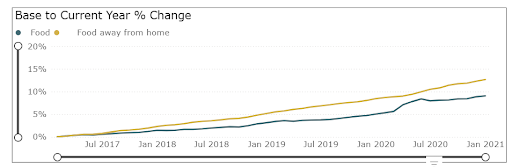
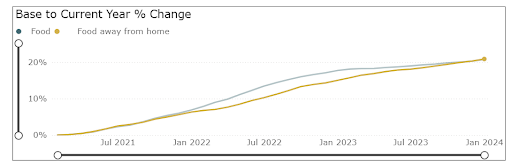
Food prices (both for groceries and dining out) were already increasing under Donald Trump—up ~10% at the end of his term. That trend continued under Joe Biden—up ~20%. You may be inclined to say one did a worse job, but given the factors mentioned above—a pandemic and HPAI—it’s impossible to state the 10% difference in price increase is the fault of an administration. Without counterfactuals, meaning models showing food prices without COVID-19, HPAI, and specific Biden administration policies, there is no economic case to be made that one president caused higher grocery store prices.
No president has the unilateral ability to address inflation.
Inflation is another one of those indicators used widely to cast blame on an opponent or claim an economic victory. Unfortunately, a President’s impact on the economy is often overstated. As economists will note, a President’s impact on the business cycle (e.g., changes in inflation and unemployment) is quite limited.
The two biggest public sector drivers of the business cycle and inflation are monetary policy and tax and government expenditures. The latter involves Congress. Monetary policy, though, is controlled by The Federal Reserve (the Fed) which is 100% independent to pursue its mandate as it sees fit. The Fed is an independent body that makes decisions largely based on economic models. So while Presidents can try to influence Fed policy (think Nixon and Arthur Burns) they have no authority over the Fed (think Trump and Powell). The President nominates the Fed Board members, but then it’s up to the Senate to confirm them and often they don’t. Central bank independence is actually a feature of all advanced democracies.
There are other channels through which the President can address inflation. A president can take a stand against price gouging by giving the Department of Justice (DOJ) direction to investigate and take action against businesses that price gouge. Additionally, like in the case of insulin, the government has large medical insurance buying power with oversight from Congress (think Medicaid and Medicare) to institute price caps on essential products. While these actions can help consumers in times of higher inflation, they are mainly unimportant channels for explaining inflation dynamics historically.
The bottom line, most of the relevant levers within the President’s grasp to tackle inflation are primarily controlled by Congress.
The U.S. Bureau of Labor Statistics’ Consumer Price Index (CPI) is the index most often used to show the inflation of the dollar. When you look at twenty years of year-to-year inflation rates plotted with the average annual 30-year fixed mortgage rate the inflation narrative is a little less cut and dry, showing fluctuations across presidential administrations.
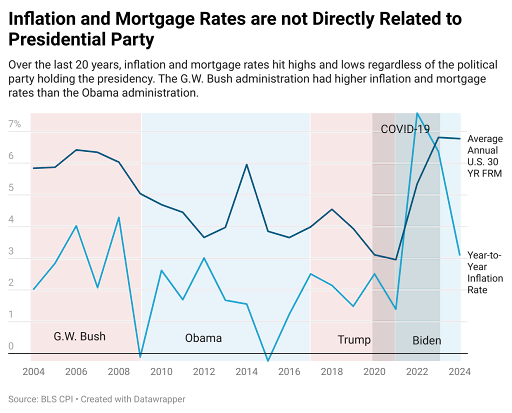
Graphing inflation across the last 4 presidencies (or 20 years) shows that there is no party (Republican shaded red and Democrats shaded blue) that consistently “wins” on inflation or mortgage rates. In fact, the Obama administration averaged both lower mortgage rates and lower inflation rates compared to G.W. Bush’s last 4 years in office. It is clear that the COVID-19 pandemic (the gray shading) was a large contributor to macroeconomic factors impacting inflation and mortgage rates. The most impacted in those years were the middle-class families who didn’t have the finances or credit to easily move homes early in the pandemic (I was one of them).
There’s no such thing as a “free” market, just a market that benefits the wealthy.
“[T]he growing insecurities and cumulative frustrations of average people who feel powerless in the face of economies (and market rules) that are not working for them generate virulent nationalist movements, harboring racist and anti-immigrant sentiments.”
Generational wealth doesn’t sound bad. But, when the divide between half of this country (50% of Americans) and the wealthiest 10% of Americans is 10-fold and widening, generational wealth doesn’t really seem accessible for all.
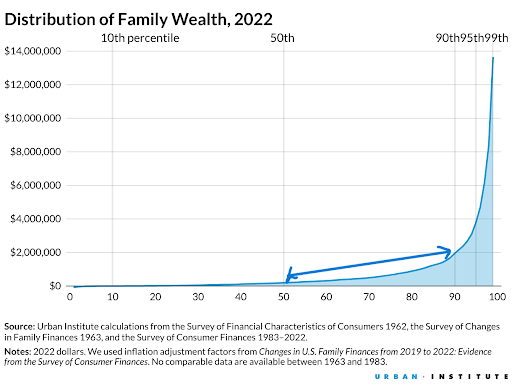
Most people no longer believe they and their children have a fair chance to make it. The market created these conditions, as former Secretary of Labor Robert Reich noted almost a decade ago in his 2015 book, Saving Capitalism. One campaign narrative today is stoking those embers, emboldening an unpatriotic nationalism, turning frustrations toward others instead of focusing on real solutions. One of the biggest fallacies being shared (aside from the prevalence of migrants committing crime at higher rates than U.S. born citizens) is that a “free” market is the solution to decrease that wealth gap and make the middle class better off. What no one tells you is that a “free” market doesn’t exist in nature. A market requires that governments make and enforce rules. In most modern democracies, the rules emanate from legislatures, administrative agencies, and courts. Government doesn’t intrude on the “free” market—it creates the market.
Instead of pointing the finger at the real issue, one campaign attempts to pull the wool over your eyes by claiming the border is why the majority of Americans don’t have nearly the wealth the top 10% do. In reality, the system, i.e. the market, has been designed to benefit corporations. Case in point, corporations can use bankruptcy to rid themselves of burdensome pension obligations (hurting the longtime employee who never invested), while homeowners cannot use bankruptcy to reduce burdensome mortgages. Seems fair, right?
The wealth gap is a race issue built on denied homeownership.
Often rooted in the argument for a more conservative approach to the economy is the lie that personal choice (specifically poor personal choices) has led to someone’s impoverished circumstances. While people, regardless of race, do make bad choices, the circumstances of most Black Americans aren’t fully explained by personal decisions. Institutional choices from insurance firms to national real estate associations to the Federal government played (and continue to play) huge roles in denying homeownership to Black Americans. Worse yet, Black WWII Veterans were denied access to loans and other mortgage benefits their white counterparts received.

The systematic denial of homeownership to Black Americans, particularly Black veterans returning from World War II, stands as a stark example of how institutionalized racism deepened economic disparities. While white veterans were given access to government-backed loans that opened the door to homeownership in burgeoning suburban communities—Levittown, PA is a prime example—Black veterans faced exclusionary zoning laws and discriminatory lending practices that effectively barred them from the same opportunities. The Federal Housing Administration (FHA) would not back loans if the building projects catered to “inharmonious racial groups.” Regardless of economic status, banks would not loan money to Black Americans without FHA backing thus allowing the government to effectively use skin color to determine who qualified. These weren’t personal choices—they were institutionalized obstacles. The grandkids and great-grandkids of those Black WWII veterans are in worse-off circumstances because of racial policies.
The government didn’t act in isolation. The National Association of Real Estate Boards (NAREB) gave explicit instructions through their 1924 Code of Ethics for realtors to maintain segregated neighborhoods.

FHA made their housing assistance contingent upon developments having these restrictive covenants in place. It wasn’t until 1948, that the U.S. Supreme Court ruling (Shelly v. Kraemer) revised its 1926 decision regarding the legality of restrictive covenants. Furthermore, it wasn’t until 1950 that the NAREB responded by revising its Code of Ethics.
The federal government’s Home Owners’ Loan Corporation (HOLC), compounded these injustices. HOLC’s color-coded maps, designed to assess the risk of investment, labeled any neighborhood with Black residents, no matter their socio-economic status, as the riskiest. This made it nearly impossible for Black veterans to secure private loans in areas designated for growth and stability, ensuring their confinement to neglected urban zones where wealth could not be built.

This deliberate marginalization created a legacy of economic inequality that continues to burden Black Americans. Homeownership, the primary means of generational wealth-building in the U.S., was systematically stripped away from those who had fought for their country only to return to a society unwilling to grant them the same rights it extended to their white counterparts. The policies of Wilson, Hoover, and even FDR prioritized keeping white families in exclusive suburban enclaves while pushing Black families into overcrowded, urban rental apartments seen as fit only for those of “ignorant racial habits,” as described in the Better Homes Manual. As a result, the economic prosperity promised to veterans after the war never fully materialized for Black families, leaving a gap that remains as wide as ever today, with homeownership rates among Black Americans still significantly lower than their white peers. This injustice not only blocked immediate access to homes, but also deprived future generations of the wealth accumulation that flows from property ownership, leaving them in a vicious cycle of debt without home equity.
Tariffs benefit CEOs while hurting consumers and farmers.
Let’s be clear, tariffs directly interfere with the global market—they are government intervention. So, to claim to be pro-”free” market and simultaneously impose tariffs is a bit hypocritical.
Tariffs are a show of force. The campaign narrative around their use against China matches a desire to purport “strength.” But, who pays the price?
When set unilaterally, like the Trump campaign is saying it will do, the tariffs may benefit some manufacturing industries currently unable to compete with Chinese manufacturing for a whole host of reasons. One reason for this is that U.S. enterprises were slow to adopt a Six Sigma approach to business processes and many are still lagging in this regard. That’s not to say that labor isn’t cheaper abroad or that producing some goods may be “dirtier” than in the U.S., there’s truth to that—there always has been. Outsourcing is a strategy used by businesses to reduce costs and increase profits—these are choices businesses make within the market.
Side note on imposing tariffs for dirty production versus clean production: that’s a carbon tax by another name. Taxing high Carbon-intensity imports isn’t a new concept—four bills were introduced in 2023. The World Trade Organization (WTO) would need to be involved to some degree, because these decisions shouldn’t be unilateral or piecemeal, but it’s true, taxing higher Carbon-intensity products can be a win for the climate. Unfortunately, with any tariff or tax, the burden ultimately lands on the consumer. In the case of tariffs on Chinese manufacturing goods like steel, the U.S. can make “cleaner” steel, but its price point will be higher, and those costs get handed off to the consumer—it’s a fact. Cheap goods come at a cost to the environment, we know this—it’s the problem that we need to solve to have a future.
Back to tariffs in general as a show of force—it’s a vicious cycle. We are all too familiar with the term “trade war,” because that’s what it is—a war. Let’s map this out. The Trump campaign is promising strength to hold China accountable (for what is still unclear) through tariffs (i.e., import taxes). Do we think China is just going to stand by while the U.S. negatively impacts their trade and economy? China will respond. As with any war, things escalate, and it’s never equally measured blows. China will reduce or restrict the import of U.S. goods. China is the #1 buyer of U.S.-grown soybeans (54% of exported soybeans go to China), generating $15.06 billion in 2023 alone. Those imports will go to the U.S.’s main competitor, Brazil. That’s a lot of large U.S. farms taking a hit if China no longer buys U.S. soybeans. These effects will be long-lasting because once Brazil takes a larger hold of the global market, it will be very difficult for the U.S. to regain those contracts. Without an export market, that soy then floods the domestic market. The high supply of soybeans on the domestic market negatively impacts every grower, even those local growers who have never traded in the global market. Moreover, farmers who have Revenue Protection Crop Insurance and/or Margin Protection Insurance will recoup some of those lost revenues and margins from the flooded market. As a result of the increased number of insurance claims and payouts, you and I—the taxpayer—foot the bill.
A very similar scenario exists for U.S. dairy, beef, pork, and poultry products where China is the #2 buyer globally, generating $4.75 billion in 2023 alone.
Imposing tariffs on China is a fun campaign narrative, but in reality, U.S. farmers are hurt and we (the consumer) face increased costs and taxes.
For those who identify as Christian, read on.
God’s economy redistributes and repairs.
We need a re-envisioning of power, politics, and faith. To get there, we examine how Jesus’ life directly challenged the domination systems of His time—systems that marginalized the vulnerable and secured wealth for a few. But this isn’t just historical reflection; this analysis confronts us with the ongoing tension between empire and God’s vision for justice, urging Christians to reclaim a kingdom rooted in equity, compassion, and non-violence. Through both scholarship and scripture, it reveals how God’s economy champions restoration over-exploitation and invites Christians to resist, rather than reinforce, systems of oppression. Through this lens, voting, community, and our own daily choices become profound acts of alignment with God’s justice and peace.
Jesus led political demonstrations against the bullies.
“(E)ven though Jesus proclaimed the advent of a new political reality, [Christians] consistently fail to connect faith and politics in meaningful and consistent ways. Instead, we Christians, vacillate between naive nationalism and a pseudo-spiritual disavow of politics.”
Jesus’ entry into Jerusalem was a direct confrontation with the systems of power that exploited and oppressed the vulnerable (i.e., the domination system). His choice to ride into Jerusalem that Passover festival was a bold and calculated challenge to those who maintained their wealth and influence by keeping others impoverished and marginalized. Remember, He spent His whole ministry up in the Galilee debating with scholars of Torah (i.e., Pharisees). It wasn’t until His last week on Earth confronting the Sadducees (i.e., corrupt and colluding religious leaders) that got Him executed. It wasn’t Jesus’ interpretation of scripture that got Him killed—Jesus’ death was a politically motivated execution. Jesus’ execution was inevitable because His ministry had already set the stage, consistently elevating the needs of the foreigner, the orphan, and the widow, while denouncing the authorities’ neglect and corruption. Jerusalem—the heart of political and religious authority—was where Jesus chose to risk everything, to expose a domination system that safeguarded the power of a few at the expense of the many.
Theologian Marcus Borg observes, “When only the personal meaning [of Good Friday], not the political, is emphasized, we betray the passion for which Jesus was willing to risk his life.” Good Friday, therefore, cannot be understood without recognizing the political dimension: it is a call to confront injustice with the vision of God’s justice. Jesus’ passion meant standing against oppression even unto death, a testament that God’s kingdom stands in opposition to all systems of oppression and exclusion. In choosing to die this way, Jesus gave followers a roadmap to resist domination systems that “other” the marginalized and restrict access to resources and justice. In every generation, in every election, the choice to follow Jesus’ roadmap of resistance presents itself anew. Nothing is neutral. We are always advancing one kingdom or the other—either the Kingdom of peace and justice, or the kingdom of control and oppression. Whether actively aligning with God’s Kingdom or passively allowing empire to persist, each choice builds momentum toward one reality or the other.
God countered wealth inequality by proclaiming liberty.
In the story of Joseph, the scarcity of food leads Joseph to centralize all wealth under Pharaoh’s control, creating a sharp divide between those who have means and those who don’t (Genesis 47:13-26). As the people exhaust their resources—first money, then livestock, and finally, land and even themselves—their desperation binds them to an unyielding economic system. Joseph doesn’t even hide what’s going on. He says, “Understand, today I have acquired you and your land for Pharaoh (Genesis 47:23a).” Joseph’s actions, for the benefit of Pharaoh and the wealthy class, set the stage for one of the earliest biblical examples of the domination system. Seeing how His own people (e.g., Joseph) can succumb to the lure of generating and securing wealth at all costs, God intervenes in Leviticus 25 with a seemingly radical solution by today’s standards: a law that commands the restoration of resources and rights in a Year of Jubilee.
God’s law, revealed through the Jubilee, is clear: “The land must not be sold permanently, because the land is mine and you reside in my land as foreigners and strangers (Leviticus 25:23).” This command goes beyond a simple redistribution; it establishes the principle that land and wealth are not to be amassed indefinitely by individuals, because it undermines the communal fabric God intends for His people. Every 50 years, the law requires a leveling of the playing field, a return of land to its original owners, and a liberation of those bound in debt or servitude. It is God’s answer to the entrenchment of inequality, ensuring that no one generation or family can dictate the future through unchecked accumulation.
The Jubilee shows God’s desire for a different social order in a world where wealth amassment often guarantees privilege. By commanding this periodic release, God protects against what we might call generational wealth, which over time can rob entire communities of opportunity and equality. God makes sure that any individual’s decision will not harm future generations indefinitely, because every family, every individual, deserves a fair start—a release from cycles of economic bondage. God’s law stands as a model of justice, a disruption of empire’s grasp, and a call for restoration that secures dignity for all.Maybe you’re thinking as a Christian you aren’t beholden to what God says in Leviticus, but remember in one of Jesus’ most known public teachings—the Sermon on the Mount—He makes it clear that He came to fulfill, not destroy Torah. Moreover, He says, “I assure you: Until heaven and earth pass away, not the smallest letter or one stroke of a letter will pass from the law until all things are accomplished (Matthew 5:18).” Yes, the apostles and first century Jesus followers wrestled with which laws gentiles must abide by, but the debate over circumcision and kosher law isn’t a debate on how to treat the foreigner, the orphan, the widow, the oppressed—that was never up for debate, then, or now.
Jesus’ strength is non-violent resistance.
“(A)s Christianity follows John (of Patmos) in emphasizing the second over the first coming, an apocalypse over incarnation, it finds itself waiting for God to act violently while God is waiting for us to act non-violently.”
The kingdom of God, as proclaimed by Jesus, was a message of peace in a world ruled by Rome’s violent dominance. When Jesus spoke of God’s kingdom, He offered a stark alternative—a kingdom built on healing and compassion, not on the trauma-inducing violence Rome imposed on its subjects. Theologian John Dominic Crossan argues that Jesus’ message was treasonous to Roman authority, yet profoundly hopeful for those longing for a reality free from fear. This was not a kingdom that promised future destruction, but one already “at hand” (Matthew 4:17, 10:7; Mark 1:15; and Luke 10:9, 10:11), offering peace through transformative, distributive justice.
And yet, the Church has often strayed from this vision, adopting a gospel of violent redemption rather than reconciliation. For centuries, a militant Christianity has preached power through force, from the Crusades to today’s militarized language in American Christianity. Dr. Kristin Kobes du Mez’s Jesus and John Wayne, highlights this persistent ideology, evident in the masculine “warrior Jesus” touted by groups like the Fellowship of Christian Athletes, who are trying to build an army for God. Jesus didn’t need or want an army, nor did He endorse strength and force as a means to peace. His command to Peter at Gethsemane, “to sheathe your sword”—even in the face of temple police (Luke 22:52) and imperial soldiers (John 18:3)—was a clear call to reject violence.
Christ’s message was that true strength isn’t in domination or conquest; it’s in unwavering acts of loving kindness—a commitment to hospitality toward all humanity. Jesus had untold power and strength. He could have called down “twelve legions of angels” (Matthew 26:53), but He chose non-violence. That’s real courage. That’s real strength. Yet modern narratives often seek to instill toughness, even hostility, in the name of Christ. Warrior language isn’t Jesus language. You can’t drill compassion, nor can you build an army for a kingdom whose cornerstone is peace that comes through loving-kindness and distributive justice. Jesus called His followers to a different mission, a kingdom where strength is defined by love for God and neighbor (even when that neighbor doesn’t look or speak like you).
Jesus wants more than a personal relationship.
Christians—since the late Victorian era (~1880s)—were invited to have a personal relationship with Jesus. That’s not evil. However, this individualistic view was not the context of the early church or the religion Jesus practiced and engaged. Rather, community was the prominent theme in God’s narrative. The Jesus movement was a community of peasants, those oppressed by the violence of the Roman Empire.
Today, however, Christianity is more a culture and political ideology than the community Jesus envisioned and died for. This culture of Christianity looks and sounds more like the militant empire of Rome than Jesus’ life and teachings.
It’s time to step away from a culture that no longer aligns with Jesus and return to the life and teachings of a Mediterranean peasant. This doesn’t mean stepping away from faith or from following Jesus, but it does require asking about the meaning of Jesus’ life and death.
So, how do I vote as a follower of Christ?
The unfortunate thing is we have a two-party system. So, on November 5 (or before) registered voters will have to make a choice. I think that choice should be to vote against whichever party more resembles the domination system’s rhetoric and treatment of the poor and cast out.
Hey, maybe in future elections we will finally have ranked choice voting (but that’s a discussion for another time). It is interesting which states have explicitly passed laws banning ranked choice voting—essentially forcing party-line voting.

What to ask when walking into the ballot box:
- Which candidate aligns most with God’s narrative of justice and peace, not just power and dominance?
- Who is focused on the common good?
- What does repentance look like for others (for example, the families of Black WWII Veterans), and are you willing to put the disenfranchised before your needs?
 The Shuvah Project